Stefanie Carbone ( she/her) is a Licensed Clinical Social Worker based in Westchester County, New York . She is a member of The National Association of Social Workers, a Certified Forest Therapy Guide and a member of the Association for Nature and Forest Therapy. When Stefanie is not spending time in the forest, she facilitates virtual mindfulness sits in her home community, conducts mindfulness trainings for school and mental health professionals, volunteers with a local bereavement center and works as a high school counselor .
In the words of John Muir
” Keep close to nature’s heart…and break clear away, once in a while, and climb a mountain or spend a week in the woods. Wash your spirit clean .” Come share in the healing powers of nature and take a mindful walk in the woods .
Shinrin-yoku is the Japanese practice of forest bathing, a therapeutic technique prescribed to patients in Japan to help lower their blood pressure and stress levels, alleviate depression and anxiety, increase immune and autonomic function, improve sleep, and boost mood, creativity, energy, and concentration. Many studies have been done throughout the world to test the efficacy of this technique with significant positive results proving it to be a viable form of preventive care and auxiliary treatment. (Holden Forests and Gardens
Japanese culture greatly values natural life, hence the cohesion of people with nature is a fundamental part of society. Though with 8 billion people in the world and 56% of them living in cities, the realistic ability of people to connect with nature without intention is low. Many would argue it is the disconnection from nature itself which is causing global rises in blood pressure, anxiety, and stress. But, taking a forest bath of any length of time can help remedy these ailments.
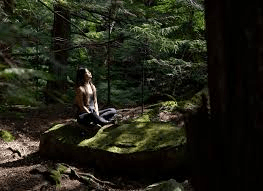
A forest bath is exactly what it sounds like, an immersion into a forest. Letting the sounds, smells, sights and feels of nature wash over you and clear your mind. It is essentially a form of meditation in nature. Whether you decide to walk or sit, take in all the sights or close your eyes, spend 15 minutes or 4 hours, it will have a measurable impact on your health. It can be helpful to try and clear your mind as you start your bath, though, the power and beauty of nature usually takes over and clears your mind as you get going.
The important part of this is to actively try and engage your senses as you go through your forest bath. Notice what you are hearing, the wind rustling in the leaves, birds singing in the trees, chipmunks skittering across the forest floor. Take note of the rich smells in the woods: decaying leaves, fresh cool air, essential oils secreted by the surrounding trees. During your bath something may catch your eye: the flash of a cardinal’s red tail feathers, a brightly colored mushroom, a battle between two insects. All of these experiences are treats from nature and help you to remove yourself from the stresses of your life therefore lowering your cortisol and increasing your mental space.
March 2025: Spring and the Healing Power of Nature
Our bodies need different things at different times of the year… and as we focus on nature and the ever changing seasons, maybe it can help us to accept the impermanent nature of everything. I think we can each say that we have a favorite time of year, and perhaps a season that we like less. Knowing that the seasons change, it’s a good reminder that our favorite time of year will come around again, and the time or season that we like less will pass… And just as our thoughts and emotions are fluid as they come and go, so do the seasons. When we know that change is around the corner, I think it allows us to give more space for the tough times with the hope that we can just observe , not judge and be with that moment…seasons of the soul. ..
And, Spring is an ideal time to nourish your mindfulness practice. With the change in seasons, boost of fresh air, and longer hours of daylight as inspiration, you can consciously invite in more simplicity, love, and compassion, and clear those habits that no longer serve you.
In the Mindfulness world, we talk about Nature as always changing, evolving, letting go, surrendering, adapting, dying—revealing to us how it is to be alive. These are beautiful lessons. If we are present in our lives, we can awaken to our own true nature and experience
When we practice mindfulness in nature, we begin to feel more fully alive and embodied—at home in the body. Many of us also often intrinsically feel at home in nature, and this sense of ease can help us learn to be present in all aspects of our life. As this sense of embodiment grows, we develop an increased ability to be kindly present to all that is arising in our inner landscape—in our sensations, body, mind, and heart—as well as in the external landscape, responding to what is happening as it unfolds. Mindfulness in nature gives us the opportunity to awaken to what is within us as well as around us, to heal and live skillfully.
I invite you to think for a moment of a time recently when you were touched by an experience of being with nature. Maybe you noticed the bud on a flower just about ready to burst into bloom, or the stillness and solidity of a tree you stood next to, or the gentle flow of water. Or the beautiful colors of a stunning sunrise or sunset. As you connect to and learn to become fully present to these experiences, you can begin to feel that you, too, can experience a sense of innate well-being. The potential to bloom and open, the solidity and fluidity you perceive in nature are all present within, for you to connect with and experience.
By calling these qualities to our attention, nature supports our intention to be present. It allures our attention and invites us to be with this moment as it is. Just like the heart of mindfulness practice is establishing a clear and kind relationship with what is here in this moment,
Science too has taught us that being in nature can slow the heart rate, reduce levels of stress hormones, and help our brains to orient to calm and natural alertness, all of which are conducive to the practice of mindfulness. .. Nature draws us in with its colors, textures, and scents: We tend to be more present in an activity when we can feel the texture of leaves, smell the flowers, and appreciate the fine details as well as the vastness of nature. Awareness of nature supports our informal practice of mindfulness, teaching us to be present in our day-to-day lives.
. “Forest bathing”—shinrin-yoku—involves slowly walking through a forest, taking in the atmosphere through all your senses, and enjoying the benefits that come from such an excursion.
“Wherever there are trees, we are healthier and happier,” it isn’t about exercising—like hiking or jogging—it’s simply about being in nature.”
Spending time in a forest can reduce stress, anxiety, depression, and anger; strengthen the immune system; improve cardiovascular and metabolic health; and boost overall well-being.
The health secrets of trees seem to lie in two things—the higher concentration of oxygen that exists in a forest and the presence of plant chemicals called phytoncides—natural oils that are part of a plant’s defense system against bacteria, insects, and fungi. Exposure to these substances, can have measurable health benefits for humans. Physiological stress is reduced, for example, and both blood pressure and heart rate are lowered. Evergreens—pine, cedar, spruce, and conifers—are the largest producers of phytoncides, so walking in an evergreen forest seems to have the greatest health benefits.
After five minutes in a forest surrounded by trees, the heart rate slows, facial muscles relax, and the prefrontal cortex quiets.
- Water and birdsong improve mood and alertness.
- Spending 15 minutes in nature can reduce levels of the stress hormone cortisol.
- Spending time in natural landscapes increases alpha waves in the brain, which are associated with calm and alertness.
- Spending an hour and a half in nature reduces rumination and helps us to be less preoccupied with problems.
- Spending two hours (120 minutes) per week in nature can make us happier and boost overall health and well-being.
- overall health and well-being.
JUNE
With summer rapidly approaching it is a good time to connect deeply with the summer season and see it as an invitation to slowdown and relax. Summer is a wonderful time of manifestation and fulfillment. Everything you’ve been putting your energy toward and working on for the past year will arrive to you during the summer season in joyful and unexpected ways. Learn to focus on the fire energy of your heart as you expand and explore your inner and outer world through summer slowdown.
2025: EMBRACING THE TRANSITION TO THE SUMMER SEASON
Summertime is marked by the light and heat of the sun. The days are longer and the temperatures are warmer, which means you may tend to be more active and spend more time outdoors. During this fiery and active season, you can trade in your previous daily routines in favor of spontaneity, social activities, and fun.
As spring transitions to summer, the seeds you planted—literally and metaphorically—during the winter have begun to blossom. And with the arrival of summer, everything comes fully awake and alive. In many ways, the energy of summer invites you to wake up and come alive as well.
Understanding and preparing for the different energies as you transition from one season into the next, enables you to flow with nature and maintain a harmony—spiritually, mentally, emotionally, and physically.
With the changing of seasons comes a shift in your own daily routines. During the busy summer months, your days and nights will inevitably get thrown off with unexpected plans so this is a good time to consider how you will stay connected with your daily practices while still allowing for spontaneity. Take some time to create a new summer schedule and be sure to leave some time for variables.
Summertime has a special way of waking you up again and igniting a fire inside to get up, get out, and have fun! The summer season is flavored by the element of fire, which influences passion, motivation, and transformation. While you’re out and about having lots of fun during summer months, you can also think of this season as a time to tap into your creativity and things that inspire you. Stepping into your own summer light and harnessing the heat of the sun, how can you get out there and shine? What makes you come alive? What sparks your creativity—and how do you inspire others? What are you needing to transform and what are you wanting to create this summer?
As you prepare to embrace the energy of the summer season, think about the things you love to do and how you like to shine. Maybe you have a unique talent or special gift you already enjoy sharing with those around you—like playing your acoustic guitar around the campfire or being the family grill master—or, perhaps you’re feeling inspired to explore something new this summer.
Mindfulness in summer is about immersing ourselves in the present moment, embracing the sensations of warmth, the sound of waves crashing, the aroma of blooming flowers, or the feel of grass beneath our feet. It’s about cultivating a deep awareness of our surroundings and our inner state of being. By doing so, we can reduce stress, enhance our overall well-being, and truly savor the essence of summer
DECEMBER 21, 2025


 FOREST TRANQUILITY
Leave a comment